Tried Going to The World's "Top Coaches" and "Top Academies" But Still Have a Broken Tennis Game?
I Will Fix Your Entire Tennis Game Permanently and Reach 4.5-5.0+ NTRP in Just 4 Weeks.
Only 6 Spots Available Per Year
WATCH THE VIDEO ABOVE BEFORE APPLYING
The video above explains the full details of the tennis program.
If you are serious about transforming your tennis game permanently, please watch the video above. Additionally, you can read the entire transcript below on this page.
On the call following your application we will NOT discuss program details. We will ONLY answer additional questions and discuss enrollment and logistics.
If you apply before finishing the video above, your application will be declined.
THIS IS THE WORLD'S MOST #1 TENNIS PROGRAM FOR ADULT TENNIS PLAYERS.
If you are:
An adult player 30+ yeras old
You started late or may have played when you were younger and picked tennis up again as an adult
You and you invested thousands of dollars into training with the world's "top coaches" and at the world's "top tennis academies" yet you are still stuck with a broken tennis game and you are not at the player level you want to be at
I myself went through the same exact experience and in this video I am going to explain why all of the mainstream "top tennis coaches" and "top tennis academies" have failed to produce the transformation you were looking for.
I've spent 7 years developing the world's first perfect tennis coaching program that uses methods you cannot not find anywhere else in the world and I'm specifically targeting adults who have already tried everything else and fail to see the results they're looking for.
Many tennis programs treat adults as if they are defective players who started too late and therefore have very little potential, and very few tennis coaches are invested in seriously training you and will immediately tell you that your potential is limited. In reality, the problem isn't you. The problem is the instruction.
IN 4 WEEKS YOU WILL:
Effortlessly dominate tennis matches and play tennis with complete and effortless fluency
Compete against professional and college players even if you're just now getting started as an adult especially if you're already a high level athlete
Learn and permanently fix every stroke in your tennis game (forehands, backhands, serves, volleys, slices)
Completely fix and clean up your footwork for good and move just as naturally as Federer
Reach a 4.5+ NTRP and UTR 7+ UTR rating
YOU MUST BE:
An athlete capable of handling 4 hours per day of on-court training Mon - Fri for 4 weeks
A healthy individual who takes care of their sleep, diet, and mindset
Highly motivated and driven to learn tennis
Be coachable and able to listen to inustructions
Willing and able to invest in yourself
Watch The Video Above Entirely Before Applying for My Coaching Program and Booking a Call With Me
In this video I’m going to explain why this 1-on-1, 4 week tennis program is the #1 program in the entire world and how it’s going to fix your tennis game permanently.
I’m also going to explain why absolutely nothing else has worked so far, why there’s no program like this anywhere else in the entire world, and why this is even above IMG academy, Mouratoglou academy, Rick Macci academy, Chris Evert academy, and also Rafael Nadal Academy.
The first thing you need to understand about my brand and coaching philosophy is that I am not the coach you go to “improve” your tennis game. I am the coach you go to when you are ready to fix your tennis game permanently. I am here to make sure you never need a tennis coach ever again. This coaching program is the ultimate, final, conclusive solution to your tennis game permanently for life.
Before you book a call with me and work with me 1 on 1, you must watch this entire video because this video will explain extensively why nothing else has worked and why my program is radically different and the first of its kind compared to anything that has ever existed in the history of tennis.
On the call, we will not discuss details of the program. The purpose of watching this video is to fully explain my coaching program. The purpose of the call is only to see if you are a good fit for the program and to discuss logistics.
I’m assuming that if you ended up here, you’re someone who’s serious about tennis, you’ve already invested a substantial amount of time and money into tennis, and you are very unhappy with where you are.
In this video we are going to cover two things:
#1. We are going to cover why every other solution has failed you - why you haven’t gotten the results you were looking for despite spending thousands of dollars on coaching with some of the “best” coaches and training at some of the world’s “top academies”
#2 We are going to cover the details of this program and how my coaching can get you to any player level.
Why Nothing Else You Tried Has Worked Despite Going to the “Best Coaches and Academies in the World”
If you’re a frustrated adult tennis player who either started late or might’ve started when you were younger and is just now getting back into tennis and you’ve already:
Tried going all over the world to multiple academies including IMG, Mouratoglou, Chris Evert, and Rafael Nadal Academy
Tried working with pro tour coaches, college coaches, former pro players, and former college players
yet you are STILL stuck, STILL not beating the opponents you want to beat, STILL not at the level you want to be at, and you STILL have broken strokes you don’t understand -
Then I’m about to explain why absolutely nothing else has worked.
#1 Traditional Credentials that Are Supposed to Signal Expertise are Heavily Misleading and You Don’t Learn or Experience This Until You’ve Invested Thousands of Dollars into Tennis
When you’re an affluent person seeking to invest into tennis instruction for the first time, the first thought is that you’re going to go to the best coaches in the world, who are usually
Someone who “coached”, “trained”, “developed”, “produced”, or “built” a notable player
Someone who coaches on the pro tour, is a college coach, or
Someone who is a former pro player or former college player
Again, you spend thousands of dollars on these people to coach you, but for some inarticulable reason you’re still stuck. I promise that it has nothing to do with you.
Let’s start with A. Here’s the problem with coaches whose authority is built on a reputation for having “coached”, “trained”, “developed”, “produced”, or “built” a notable player:
Notable players who have achieved high success like becoming a state champion, national champion, collegiate player, or professional player have often had hundreds of thousands to millions of dollars spent on their tennis game and have trained under as many as 5-15 different coaches.
So when a coach claims to have been associated with the development of these players, they often omit this context. They often leave out the influence of all of the other coaches you don’t know about and the influence of the immense capital invested just to teach someone how to slap a ball around.
Coaches often advertise who they trained but never what they taught because they know that if they’re associated with the right player, everyone will think they’re a credible authority, and then they can justify having you pay them first for access to information.
You have no idea what they contributed to notable players they claim credit for, and you have no idea if whatever they teach will even work for you until you pay them. Again, if their coaching was working for you, you probably wouldn’t be here.
Many players don’t realize that there has been a perpetual generations long quiet rat race for coaches who are looking to make a name for themselves just because they produced one superstar even though the vast majority of their players fail and they have no real curriculum or system. There’s no telling whether their methods are actually reproducible at scale.
Now let’s move on to B. You initially may think that if you go to a pro tour coach or a college coach that you’re getting the best tennis coaching in the world. Here’s the truth. A tennis coach’s job boils down to 3 things:
Actually teaching and fixing technique
Running drills that progress and maintain different skills
Being a hitting partner/matchplay partner.
If you’re struggling with a broken tennis game, what you need most is 1 and 2 - not 3.
The truth about pro tour coaches is that they do not train or work with beginners or players with significant technical issues. They do not actually teach and fix technique from scratch. They aren’t the ones fixing broken strokes.
They only begin working with players until after players reach a certain level of proficiency. And players don’t become proficient by themselves - they got there because of all of their prior coaches.
Pro tour coaches will pick up a proficient player who is the product of the combined effort of previous coaches, and when you look at real pro tour coaching sessions. The actual training is:
60% hitting partner that is talking a lot
35% of it is running drills every experienced coach knows
5% is granular one-time technical tips and tidbits.
Furthermore, 90% of professional tennis players do not even hire a coach because it’s easy to find hitting and drill partners for free.
When it comes to college coaches, college coaches are primarily recruiters. 60% of D1 tennis talent is imported from overseas yet we then tend to give college coaches credit for having “produced” a successful team or season.
As someone who has played a semester of D1 college in 2019 and has witnessed college practices as many of you may have as well, many college practices are simply identical to high performance group tennis practices as well as 5.0 USTA team practices. You do the same identical ball drills, rally patterns, and matchplay as anywhere else. Therefore college coaches are generally 100% #2, which again is someone who runs drills.
They may offer pep talks and motivational speeches, but at the end of the day a college team is only as good as the players it recruits, and college players are often pre-built by other coaches as well. The “top colleges” are the ones that simply have a reputation for being the best. And because they have a reputation for being the best, the best players simply want to go there, creating a positive feedback loop of generating the best results not necessarily due to the work of the college coach alone.
And lastly a college tennis team isn’t a real team. It’s a roster. A soccer, football, or baseball team are a real team, because every player is on the same court or field, and the coach is legitimately conjuring strategies and commanding what plays the team should execute and where each player should actually be located. A college coach simply has to match the UTRs of their players with that of another team’s roster. Every tennis player is on their own court (with the exception of doubles, which is still nowhere near as strategically complex as one entire soccer, basketball, or football team versus another)
Now let’s move on to C. Lastly, you might think that a former professional tennis player or college player is “highly knowledgeable” when it comes to tennis. Here’s the problem with this: someone who’s been taking lessons their entire life has never had real experience giving them.
They’ve spent their entire life developing their own tennis game but they’ve never had to solve the problems of other tennis players, especially those who start at completely different levels, have completely different developmental profiles, and are starting at different ages.
Many of you have experienced high-level players who are able to produce miraculous strokes and shots but cannot explain why. This is because just because you are capable of performing autonomic reflexes does not mean you have a cortical understanding of how our body works.
All of us know how to move our bodies in basic ways like writing, texting, or typing. None of us know what muscles are involved or even what muscles are in our own body. Therefore even though all of us know how to move and live in our own bodies, that doesn’t make us anatomical or technical experts on being able to explain how our body actually moves.
So again, what I’ve done here is that I’ve fully explained #1, why traditional credentials that are supposed to signal expertise are heavily misleading and you don’t learn or experience this until you’ve invested thousands of dollars into tennis.
I’ve explained why you’ve trained with either:
Someone who “coached”, “trained”, “developed”, “produced”, or “built” a notable player
Someone who coaches on the pro tour, is a college coach, or
Someone who is a former pro player or former college player
and why even though these three categories of coaches are supposed to be the most credible authorities in the tennis world, why all three of them fail you.
#2 Why The Biggest Academies Like Mouratoglou, Chris Evert, Rick Macci, IMG, and Rafael Nadal Academy Still Fail You
This brings us to #2, which is why some of the biggest academies like Mouratoglou, Chris Evert, Rick Macci, IMG, and Rafael Nadal Academy also still fail you.
These tennis academies have powerful brands. They know that people are practically guaranteed to come because of the brand they possess alone.
Now one of the reasons you go to an “academy” is because this branding title implies a codified curriculum and a uniform methodology.
In reality, many tennis academies are only nominally academies. They:
Give the same beginner, intermediate, and advanced group sessions as every tennis facility does
Have hourly private lessons like every other facility does, and
Have summer, winter, and spring programs like every other facility does
The business model of a tennis academy, tennis club, tennis center, or any tennis facility in the world is not to graduate you or fix your tennis game permanently. It’s to deliver an emotional, high vibe, luxury experience where you feel like “a part of something”, and have you coming back. It is vibes over functional results.
In addition, another allure of academies are all of the “champions” that you see being “produced” here. But what you never know is again the omission of very relevant context. You never know how many coaches these successful players had and how much in total they invested into tennis.
Furthermore, the turnover rate of coaches at these academies is anywhere from 1-3 years generally with the exception of senior positions like head coaches and tennis directors. Therefore whatever coaches may have had a significant impact on the career of the players that the academy takes credit for might not even be there anymore.
You may be going to an academy that is known for having developed a national champion or professional that inspired you to go there without even actually knowing if the coaches responsible for this development are even there anymore.
So overall:
The “academy” branding title is misleading
The success stories are misleading
Coach turnover rate is relatively high to ever suggest that there is a special methodology occurring at these academies
The academy business model is inimical to true player development
The “academy” brand pretends to be a codified curriculum and methodology that isn’t actually there.
Now although all of this may sound like cynicism, and all of this is unfortunately hard to believe any of this until you’ve actually experienced firsthand having investing everywhere looking for the best instruction first-hand and not getting top results. Many of you have, including myself and many of my clients. And lastly, now you have the full all-encompassing explanation of why previous coaches with the top credentials and previous top academies with the most powerful brands have failed your tennis game.
I myself have also experienced having thousands of dollars spent on my tennis game, training with multiple coaches, and hoping to make significant progress with each new coach.
I was lucky to start tennis at a young age, but you don’t have to. The truth is that tennis players take years to develop because we spend a lot of time and money wading through dozens of coaches and mindlessly absorbing information. Some players make it. Most don’t. Either way, this is a problem in the market that practically nobody is addresses at all or at best they consider this experience an inevitable feature of the sport.
In reality there is a much better solution to gambling your time and money away to uncertainty.
Here Are the Limiting Beliefs About Tennis That You Need to Completely Get Rid Of in Order to Move Forwards in Your Tennis Game:
The idea that tennis takes “years to learn”
The idea that tennis is “highly technical”
The idea that “you have to start young in order to get good”
The idea that “your potential is capped if you start as an adult”
The idea that “you need natural coordination to get good at tennis”
The idea that “you’re never done learning tennis” or “tennis is a lifelong learning journey”
In addition to all of the prior reasons that I stated earlier in this presentation, the ultimate and main reason that every single other coaching program has failed you is because at the core, everyone in the industry believes these are true. There is no coaching program in the world that holds these limiting beliefs at their core that will ever deliver you lasting results.
I’m going to dissect each one of these limiting beliefs one by one
“Tennis Takes Years to Learn”
First, the idea that “tennis takes years to learn”, that “you have to start young in order to get good”, and that “your potential is capped if you start as an adult” are practically the same thing.
Tennis does not take years to learn. People believe this because they see players training for many years. In reality what takes years is finding the right coach. Like I said earlier, successful top players have often had many different coaches, and it’s practically impossible to sort who contributed what and whose advice really moved the bar forwards, especially when there’s so much contradicting advice.
Tennis takes as long to learn as it takes you to find the right instructor. If you’re training under bad instruction, it’s going to take years. If you’re training under the right instruction like this program, you’ll be done in four weeks.
“Tennis is Highly Technical”
Next is this idea that tennis is “highly technical”. A car differential or a particle accelerator is highly technical. Tennis is not.
Every tennis stroke is just made out of 14 anatomical movements. All of the footwork on the court is a simple catalogue of quantified locations and a quantified set of ways that you can move to these locations.
Many people who call tennis “highly technical” can ironically never give a solid technical breakdown of the sport without mixing up their explanations, or contriving a bunch of tips.
“You Need Natural Coordination to Learn Tennis”
Next we have this idea that you need natural coordination in order to learn tennis. Many “experts” say it takes years to become coordinated. In reality it only takes an hour.
The “experts” who say it takes years to become coordinated build coordination through useless throw and catch drills when there is a method orders of magnitude faster at developing player coordination. Throw and catch is useless for developing tennis specific coordination because tennis specific coordination is not about catching a ball at any location the same way that soccer coordination has nothing to do with archery coordination.
A player’s tennis specific coordination comes from two extrasensory adaptations that developed tennis players have and that underdeveloped tennis players lack. Those two extrasensory adaptations are contact awareness and trajectory perception.
“You Need Natural Coordination to Learn Tennis”
Here’s the formula for building contact awareness:
Teach the player the proper stroke
Put an object at the point of contact like a disposable racquet handle and have them hit it over and over again.
Done. This is called contact training. After 5 minutes contact training, you entrain the player’s body to expect physical contact at a particular felt location along the path of the swing. The traditional method of acquiring this would have you hit thousands of balls until you figure out which point of contact sends the ball where you want. This is the real time consuming method that will have you spending years trying to “develop coordination”.
Once you have contact awareness, you have a non-cortical felt awareness of where you need to make contact with the ball
“You Need Natural Coordination to Learn Tennis”
The next thing you need is trajectory perception. Even if you have an accurate felt expectation for where to make contact with the ball, you need to actually be able to read where shots are going, which is trajectory perception. Now here’s the formula for building trajectory perception:
Start close and toss the ball to the player from their side of the court
Back up slowly, tapping balls to them while you’re still on their side of the court
Eventually back up to the other side of the court until you’re all the way at the baseline of the other side
That’s it. This is called gradual distance expansion. This is how you have players able to read the trajectories of shots that come from the other side of the court in less than an hour that they were previously unable to properly assess and position themselves for.
The exact formula for tennis specific coordination is contact awareness + trajectory perception. These two identifiable extrasensory faculties are normally developed slowly across a player’s training career through the brute force of ball volume over years and as a result, no one actually ever notices that they develop them, and no one ever recognizes or itemizes these extrasensory faculties as a “thing” that they now have that beginner tennis players simply do not.
This of course also creates a disconnect between the former pro player who and a beginner or intermediate like you they may be coaching, where they can’t seem to understand why you aren’t “coordinated” or why you aren’t able to make contact properly on certain broken strokes you may have and attempt ball toss drills or “dominant eye” coordination drills.
Because my coaching system has properly and successfully itemized these extrasensory faculties and no one else in the world has, we can then directly manufacture coordination with unbelievably simple exercises like contact training and gradual distance expansion.
“You’re Never Done Learning Tennis”
Lastly we have this limiting belief that you’re “never done learning tennis” or that “tennis is a lifelong learning journey”. This statement is merely performative humility. Functionally it results in zero accountability or real planning, systems, and curricula development when it comes to tennis. Functionally, it results in you mindlessly spending years going from coach to coach and absorbing tips and fragments of information that fit together.
Furthermore, it’s very clear that there are some players who make it to 4.0-4.5 NTRP in just their first year of playing tennis while many others remain stuck at 3.0-3.5 NTRP for years. And even though few are able to articulate the mechanics of strokes, everyone can clearly recognize the aesthetic mechanics of a proper forehand as well as the fact that it clearly produces control over the ball and desired shot placements
There is a finish line to tennis, and this is the first tennis program in the world that will give you a proof-of-concept system again not for “improving” your tennis game, but for fixing and finishing your tennis game permanently.
With that being said, now that we’ve covered why nothing else has worked before and we’ve debunked all of the limiting beliefs you may have had about tennis, let’s get into the actual details of my coaching program.
Program Description
First let’s start with your actual goals because many of you have different goals coming into this program. You likely have one of the following goals:
Fix your entire tennis game
Get to a high player rating like NTRP 4.5+ or UTR 10+
Beat your spouse or friends at tennis
Win more matches
Go pro
All of these are possible through my program.
What I’m going to do is explain how to become a professional tennis player, because even if this might not be the goal that you have, my job as a coach isn’t to tell you what you can or cannot do. It’s to lay out the entire potential space and tell you exactly how to get wherever you want to get to, and in doing so I will also explain how my program will get you there.
Hypothetically if you wanted to become a professional tennis player, you literally only need to follow two steps:
Step 1 - Finish learning tennis
Step 2 - Get in shape.
That’s it.
What many people underestimate is that your NTRP or UTR is not all about tennis. Your fitness matters substantially. Your player rating is a significant product of not just your tennis skill, but your tennis fitness. However this is often obfuscated because rating systems like NTRP and UTR are often called “skill levels” - and because they’re called “skill levels”, people focus completely on technique and radically neglect the role of fitness.
In addition, most of the content on the internet concerned with how to hit harder shots or increase your player level heavily defines technique as the problem, but never fitness. As a result, many players end up continually spending thousands of dollars on tennis lessons when what they need isn’t another coach but to prioritize physical training. There are many tennis players out there who literally do not need more coaching. They need more physical training.
Thus I want to clarify that the value that this coaching program contributes is for players who have broken technique, broken strokes, and are lost in their tennis game - not for competent players who think they need another coach when their 40mph recreational forehand is simply too slow to compete with 60mph professional forehands.
So again, with the idea in mind that becoming a professional tennis player is a 2 step process that involves step 1: finishing learning tennis and step 2: getting in shape, we are actually going to start with step two. You never have to wait to actually get in shape, and some of you who are enrolling in this program may be in better shape than others.
Getting In Shape
Let’s talk about the physical fitness standards you need to meet in order to go pro, because what everyone commonly believes is that becoming a professional tennis player is a product of random chance and genetics - not the truth which is that taking the correct actions that get you the right results.
If you were to join the military or any branch of the armed forces, the first thing that they give you is a list of physical requirements that you need to meet in order to pass basic training. In tennis, no such physical standards are ever elucidated.
In order to “physically qualify” for professional tennis, you must be able to produce a certain shot speed, footwork speed, and endurance. I put “physically qualify” in parenthesis because technically there is nothing preventing you from playing in a low level professional event, but at the same time no one ever tells you what professional players are generally physically capable of.
With that being said, you can still be far below the fitness level of a professional player and enjoy a proficient tennis game where you dominate many opponents. After all, professionals have ratings of NTRP 5.5+ and UTR 11+ and are amongst the top percentile of players.
First, here are the following shot speeds you must be able to perform as a professional tennis player on the men’s tour specifically:
Your topspin groundstrokes must be 60-70mph
Your volleys and slices must be 20-40mph
Your serve needs to be 100-115mph
Technique alone does not get your strokes up to this speed. Deliberate physical training is necessary.
Secondly, the next thing you need is footwork fast enough to acquire shots of these speeds.
And lastly, the final thing you need is endurance to sustain this level of performance. A professional event can last anywhere from 7-10 matches with 3-5 sets per match over 9-10 days. Therefore you essentially need to be able to maintain this level of performance for 21-50 sets over 9-10 days.
That’s it.
Now it’s finally time to get into the main part of this video, which is how to finish learning tennis and finally fix your tennis game permanently after going all over the globe to tons of supposedly notable coaches and tennis academies.
How to Finish Learning Tennis and Fix Your Tennis Game Permanently
My system for fixing your tennis game permanently is simple. You only need to learn 3 things to finish learning tennis permanently:
You need to master every single tennis stroke
You need to master tennis footwork
You need to master tennis strategy
Until now, all of these topics have been poorly defined, poorly itemized topics. I am going to give you an extremely clear itemized curricula and even explain why it’s very easy to learn all of them.
Up until now you have likely been receiving a lot of “vibes” tennis coaching and a lot of tips, tidbits, analogies, and metaphors. In this program, I’m going to give you a very clear structure.
Mastering Every Tennis Stroke
Let’s start with mastering every tennis stroke. There are only 7 strokes in tennis:
Topspin forehand
Topspin backhand
Forehand volley
Backhand volley
Forehand slice
Backhand slice
Serve
There are indeed multiple variations of each stroke as well, and all of them are quantified as well. We cover them in person during the training but they are also covered in my free videos and online courses.
Again, tennis strokes are often taught in tips, tidbits, analogies, and metaphors, but in my program I teach you using real biomechanical methods. Furthermore, many coaches will claim to teach you biomechanics, but never actually explain the muscle groups you are using. My proprietary coaching system has correctly identified and itemized that every single tennis stroke is only made of 14 core muscle movements -
Front raise (front deltoids) - Used in the forehand and two-handed backhand
Front downwards pull (lats) - Used in the serve
Side Lateral lift (center deltoids) - Used in the one-handed backhand, backhand volley, and backhand slice
Side Lateral pulldown (lats) - Used in forehand, one-handed backhand, and two-handed backhand
Chest fly (chest)- Used in forehand followthrough, one-handed backhand preparation, two-handed backhand preparation, forehand volley, and serve
Rear deltoid fly (rear deltoid) - Used in the one-handed and two-handed backhand swing
Face pull (rear deltoid) - Used in the one-handed backhand finish and horizontal two-handed backhand finish
Shoulder rotation OR rotating the arm (rotator cuff) - Used in in the forehand, serve, forehand slice, and backhand slice
Bicep curl OR bending the elbow (bicep) - Used in the serve and two-handed backhand
Tricep extension OR extending the elbow (tricep) - Used in the backhand slice and backhand volley
Wrist bend flexion & extension OR “bending the wrist” (forearm flexors and extensors) - used in the forehand and serve
Wrist turn pronation & supination OR “turning the wrist” (many wrist muscles) - Used in the forehand and serve
Wrist wave radial & ulnar deviation OR “waving the wrist” (many wrist muscles) - Used in the forehand while brushing
Ab crunch - used exclusively in the serve followthrough and overheads
The same way that all of the matter in the universe is made out of the 118 elements on the periodic table, all of the strokes in tennis are literally constructed from these anatomical motions. The same way that engineers use mathematics, my coaching uses biomechanics and anatomy. Not “vibes” coaching. Not tips, tidbits, analogies, and metaphors, although the occasional tip and analogy may be useful peripherally, not centrally.
In the next several slides I am going to brief you with the biomechanics of every single tennis stroke so you have the anatomical clarity I promised I would deliver through my program.
Topspin forehand: [Front raise + chest fly] → [horizontal bicep curl]
Two-Handed Backhand:
Left arm: [chest fly + front raise] → [diagonal bicep curl]
Right arm: [rear delt fly + lateral raise] → [vertical bicep curl OR single arm face pull]
One-Handed Backhand: [rear delt fly + lateral lift]
Forehand volley: [bent elbow chest fly diagonally downwards] → [slight front raise]
Backhand volley: [diagonally downwards tricep extension] → [slight lateral raise]
Forehand slice: (identical to forehand volley but longer)
Backhand slice: (identical to backhand volley but longer)
Serve:
Preparation to trophy position: [shoulder rotation downwards] → [bicep curl + hung wrist
Trophy position to swing: [chest fly + tighter bicep curl] → [tricep extension + shoulder rotation outwards] → [bend wrist forwards + rotate forearm counterclockwise + straight arm pulldown] → [ab crunch]
Again, these are briefly the biomechanics of every tennis stroke but there are more versions that we will cover in our in person training.
In addition to learning proper form for each strokes, we run drills that develop your ability to:
Control power
Control spin
Control direction
Therefore each stroke goes through the following process:
Develop the stroke
Add footwork while executing the stroke
Develop different aspects of the stroke (spin, power, direction)
Combine it with other strokes
After repeating this 4 step process for all 7 strokes, you become fluent in switching between every single shot at will. From there, you develop a full tennis game.
Mastering Tennis Footwork
This leads us to mastering tennis footwork. Traditionally, tennis footwork is an extremely underdefined field consisting mostly of running you through a random set of “footwork patterns” and drills under the hope that brute-force high volume footwork drills will eventually install “natural footwork habits”.
Instead, my training program explicitly maps exact locations on the tennis court, and exact instructions on how to move to these locations. Therefore you aren’t learning random patterns, you are training exact option sets for explicitly defined court locations.
Every stroke in tennis (except the serve) has an associated footwork map - a:
Topspin forehand footwork map
Topspin backhand footwork map
Forehand volley footwork map
Backhand volley footwork map
Forehand slice footwork map
Backhand slice footwork map
(image in video)
This is the entire set of instructions for each footwork map that we will cover. This is an intellectualized understanding that has been crystalized into documentation but of course when we train in person, you will not be bombarded with intellectual explanations - I will simply have you execute the proper techniques. It’s not necessary for you to remember everything as explicitly as I do when I instruct the content. What will happen is that you’ll simply learn how to move naturally without thinking about it the same way that you know how to drive without thinking about it either.
Mastering Tennis Strategy
Now that we’ve covered all of the tennis strokes and all of the tennis footwork, then and only then do we move on to tennis strategy. One of the biggest mistakes that players make is that they try to study strategy before they have fully developed strokes and footwork. Strategy only becomes applicable when your entire tennis game has been developed.
In tennis, there are only 3 strategies at any given time:
Neutral strategy which is trying to stay in the point
Offensive strategy which is trying to end the point via winners and drop shots
Defensive strategy which is trying to save the point by responding to attempts by the opponent to hit winners and drop shots
Specifically, there is only one neutral strategy, but there are 3 types of offensive strategies, and 3 types of defensive strategies.
Offensive strategies:
Groundstroke, approach shot
Groundstroke, approach shot, volley
Groundstroke/serve, volley
Defensive strategies:
Defense against offensive strategy 1
Defense against offensive strategy 2
Defense against offensive strategy 3
The attempt to execute one type of each strategy can lead to other exact types of quantified outcomes depending on the successful or unsuccessful execution of the strategy. This is what the diagram on the right shows - an entire causality structure of every single possible event that can occur in any and every tennis point.
Traditional tennis strategy instruction will throw a catalogue of thousands of plays at you and attempt to memorize them all through brute force practice and neglect whether or not you have the technical foundation to even apply them. Through this strategic method, you actually learn exactly what to do when and where.
And again, you won’t have and it will not be necessary for you to have an intellectualized understanding of tennis strategy. You do not need to memorize this entire map. You simply need to know exactly what to do in the moment.
I also have a book covering all of this content published on amazon called “The Complete Map of Tennis Strategy”. Regardless, we will train and cover all of this content in our in-person training.
That’s Everything.
So far in this presentation what we’ve covered is:
Why you’ve invested an immense amount of time and capital in tennis and haven’t seen any results
Why all of the limiting beliefs you’ve been told about tennis are completely false
The physical standards you’d need to meet if you wanted to go pro
How to learn tennis, master tennis, and fix your tennis game permanently through my program
Here’s What This Program Can Do and What it Cannot Do
My job as a tennis coach is literally nothing more than teaching you tennis correctly. Although I can provide workouts and training suggestions, I can’t make you train in the gym and I can’t make you stick to a diet. I don’t control what fitness level you have coming into this program and whether or not you’ll remain fit and disciplined in the future.
I can only promise you that my program is the final solution to your tennis game and that through my program you will never need another tennis lesson, another tennis coach, or another tennis experience for the rest of your life. You will be able to play tennis fluently like a natural child prodigy who already has pro level technique at age 10.
Your results at the end of this program concerning your player rating in terms of NTRP or UTR will vary heavily based on your level of fitness. This is again because as I explained earlier, your player rating is not the product of your tennis game alone. It is also the product of your strength, speed, and stamina.
By the end of this program you will be no lower than a UTR 6 or NTRP 4.0 assuming you have below average strength, speed, and stamina - and if you have world class or elite levels of strength, speed, and stamina, you will end up as high as NTRP 6.0+ and UTR 13+.
My program does nothing but add a perfected tennis game to your current level of fitness.
If You Are Ready to Enroll…
There are only 6 spots per year. Click the link below and it will send you to an application form to fill out so I can learn more about your situation and your tennis game.
After that you will be able to book a call with me and we will discuss enrollment into the program.
Click the link below to get started.
Addendum: The Real Secret Reason Why I Do This
Because this will be a very intimate one-on-one mentorship where both you and I will be investing significant time into this project, I think it's necessary to explain why I do this so you have a greater insight into the type of person I am so that this doesn’t feel merely like some transactional relationship and so that you feel like you’re training with someone who’s actually aligned with the type of person you want to interact with as well.
The truth is that secretly, I never gave up on my own tennis game. I've experienced the same exact path as many of you where I trained with a bunch of coaches, watched a ton of videos, and was frustrated for a very long time. The only difference is that I got to start young and I had the time and freedom from worry to be able to develop a tennis game through the brute force of trial and error.
However even though I’m one of the lucky ones to successfully develop a competent tennis game, I didn’t have a conscious understanding of it (like many of us), and there were still many players who failed. Like I said earlier in the presentation, everyone says that you have to start when you’re young in order to get good, but if you look at the real failure rate of players who start as kids versus adults, from personal inference it’s practically almost identical.
Furthermore, the block to learning tennis as an adult is not technical. It’s instructional. Kids don’t learn “fast” because they’re young. They learn “fast” because usually many talented junior players have parents with practically unlimited resources or they throw everything they can into tennis, and they have the luxury of trying many coaches. As an adult and as someone who is sensitive to the value of their time, this is something that you don’t have or are unwilling to tolerate - and this is absolutely reasonable.
My approach to tennis coaching and everything in life is the idea that there is always some form of core, perfectly compressed representation of knowledge and that everything can be quantified, clearly articulated, and systematized. When it came to tennis, I was particularly relentless with this. I wasn’t satisfied with the idea that tennis has to permanently be taught in tips, tidbits, jargon, and metaphors. I was always looking for the fastest way to teach players and produce results. I didn’t accept the idea that tennis took years to learn just cause
Furthermore, there simply aren’t any explicit models, systems, or written down instructions for tennis anywhere that aren’t merely “nerded out” and hyper-intellectualized explanations, but that are immediately applicable and can produce immediate results. The instructional industry again is plagued with tips, tidbits, analogies, and metaphors. The information is extremely fragmented, incoherent, and seemingly full of tons of contradictions and exceptions. And at the end of the day, everyone just believes tennis is hard and heavily technical and unquantifiable anyways. The easiest thing for the average person to do is accept this. But I refused to do that, and you are likely the same.
Lastly, if I could create a perfect instruction set for tennis, then I could use it on my own tennis game. Many coaches cannot go back in time and remember what it was like to be a beginner tennis player. I believe one of my intrinsic talents here is that I am able to do this. This is why I’m able to identify that beginners do not have certain extrasensory faculties like contact awareness and trajectory perception, yet the fact that beginners and intermediates either lack this or have a corrupted sense of these is something that is invisible and undetectable by many instructors.
Furthermore I wanted a crystal clear answer as to what it actually takes to ascend player levels. Many people will not give you an explicit but nuanced explanation that your UTR or NTRP is not the product of technical refinement alone but that your physical ability matters substantially. Additionally I have never heard anyone itemize explicitly what exact shot speeds, footwork speeds, and endurance that you needed to compete professionally.
Now that you have an itemized list of physical qualifications to meet in order to compete professionally, who am I or anyone to stop you from training to meet those qualifications? Because before then, the average coach would’ve just told you that “it’s a matter of chance” or “only a small percentage of players go pro” without any further explanation.
I’ve seen plenty of adults in their 30s, 40s, and 50s who have taken care of their health and who are just as capable as even some high level athletes who are currently in their 20s. Like I said near the beginning of this presentation, it is not my place to tell you or anyone how good you can or can't get.
Ultimately at the end of the day, even though I’m known and seen as a highly proficient coach, the truth is that I’m another player just like you who embarked on a journey of actually studying the sport. However most people’s idea of “studying” is watching videos, not really understanding what they’re looking at, and then jotting down tips and tidbits.
My idea of studying was actually developing a coaching system, continuously taking notes from real lessons, writing hundreds of lesson plans, testing different instructional methods on players of all ages and backgrounds, truncating ineffective methods, retaining effective methods, and crystallizing my work and methods into explicitly writing curricula, diagrams, and produced videos.
I embarked on coaching tennis as an extension of studying the sport because I wanted to study the sport because I hadn’t given up on my tennis game. And I’d already had enough lessons from supposed “experts” and I’d already watched enough online videos from other creators and overall I was thoroughly convinced that nobody was worth investing any more time or attention into and that I had to figure it out by myself, and I did.
In total throughout my life I’ve only had about $18,500 invested into my tennis game and got to a career high of about a UTR 7-8 and an NTRP 4.5. The only reason I did not continue to train is because my family ran out of money to keep investing into tennis when I was 17. When I looked into and researched how much money parents usually invest into their children’s tennis game, I learned that most parents invest anywhere from $100,000 to $400,000 in their children just to get them to a UTR 7 as well. This is absurd.
In addition, it was easy to think at the time that if I just had more financial resources that I could’ve gotten a much higher player rating. In fact, I also couldn’t help but imagine how many tennis players are out there with extreme potential but no resources to invest in themselves. But as I said before, what matters more isn’t the amount of time or coaches you work with, but getting the right instruction. And even today, knowing everything I know, I can confidently say that even if I had a million dollars in my bank account, there is no other coach in the entire world that I would spend a dime on.
I went on to study tennis for me. But I couldn’t truly study tennis without actually coaching tennis as well and seeing what really works. And after 7 years of coaching tennis, I’ve finally created the world’s #1 tennis program and system that has ever existed in all of tennis history. A proof of concept system that works on anyone. The best system is a proof of concept system. Not a system that only turns a handful of players into pros or college players. Not a system that only develops a couple of national or state champs. A system that develops anyone.
The pursuit of my personal interest is intrinsically aligned, coherent with, and entangled with a project like my work that is integral to the expansion of the potential space of possibilities in the tennis world, which for decades has stagnated immensely. Every student I successfully train is not just proof of my production capability but proof that even my own intrinsic potential hasn't extinguished either.
You are training with someone who is primarily fueled by life-long indignation towards wasted potential and an unwillingness to tolerate mindlessly collectively imposed limitations. You are not training with someone who is merely doing this for the sake of performative postures like “for fun” or “out of passion”. You are training with someone who is serious about attaining an exact functional result.
If you are ready to get started, click the link below and fill out the form.
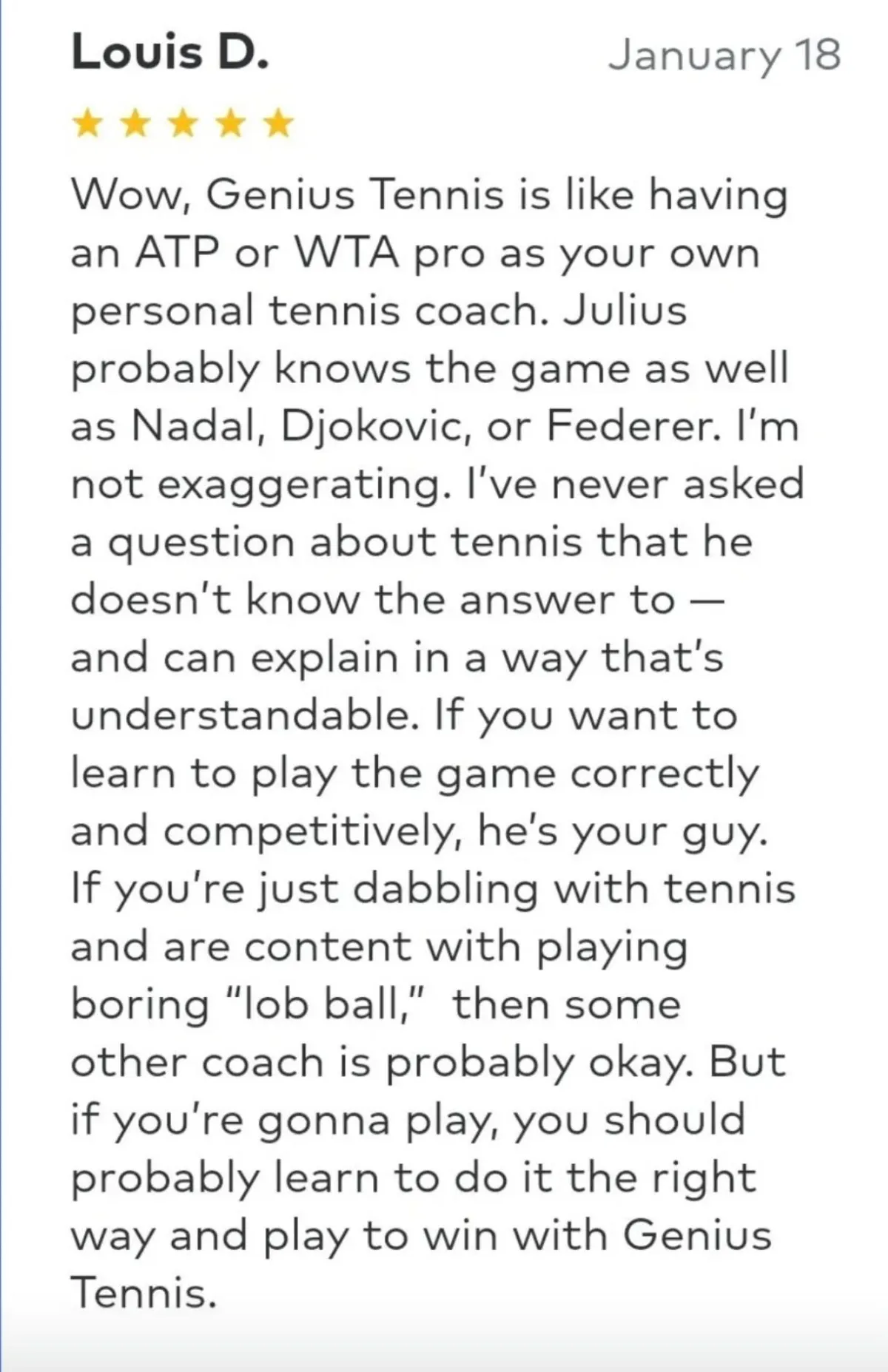
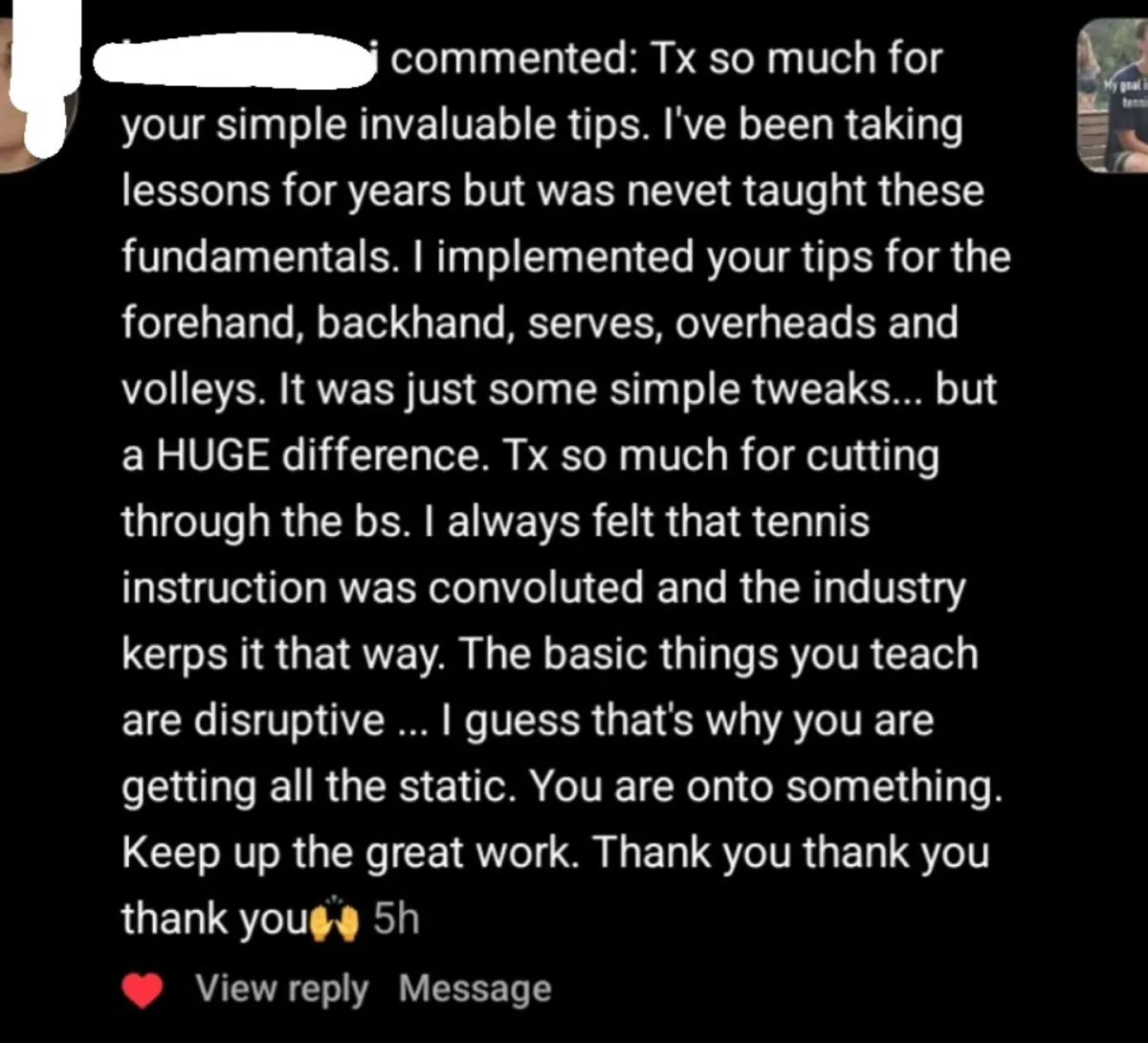
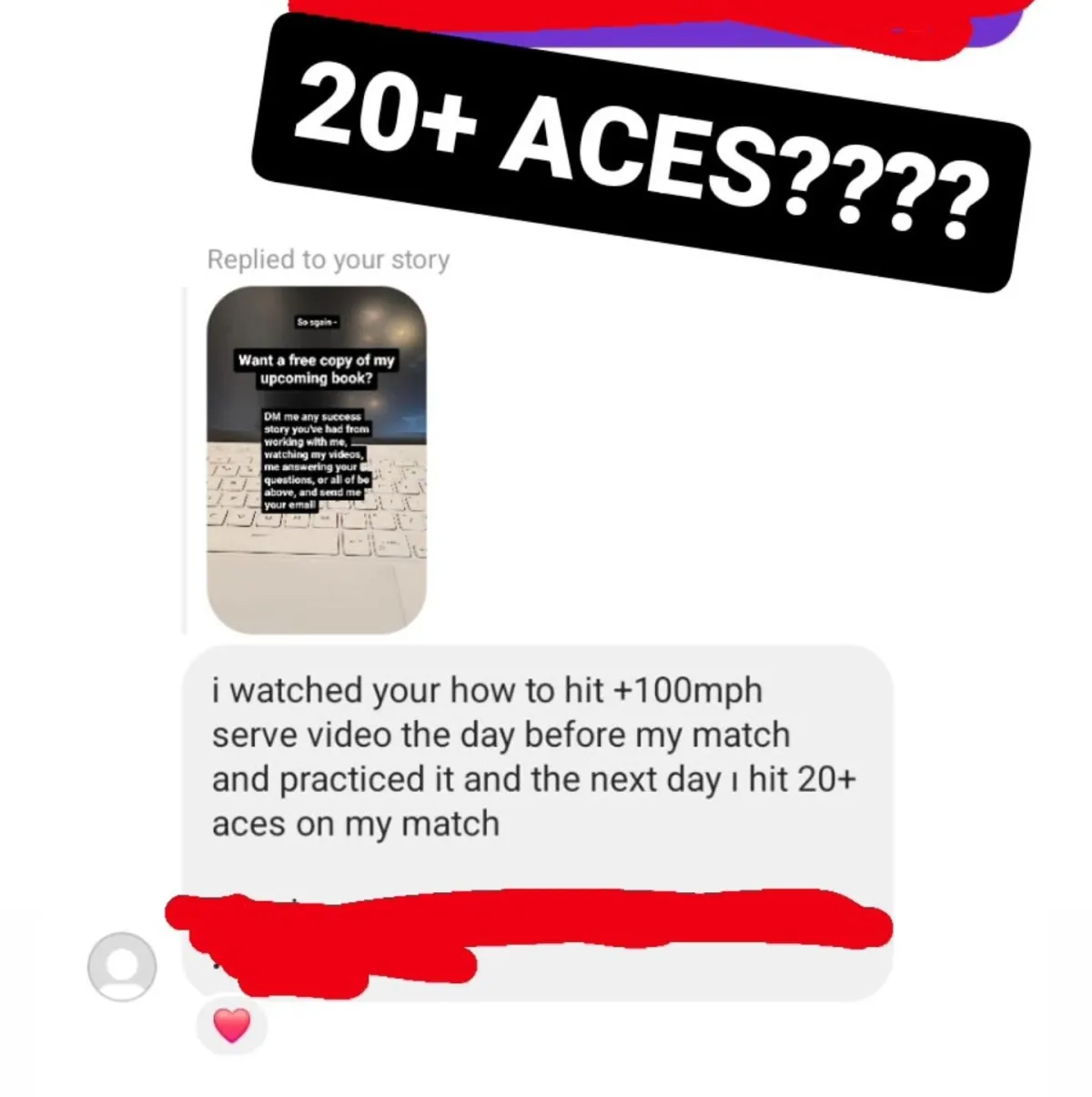
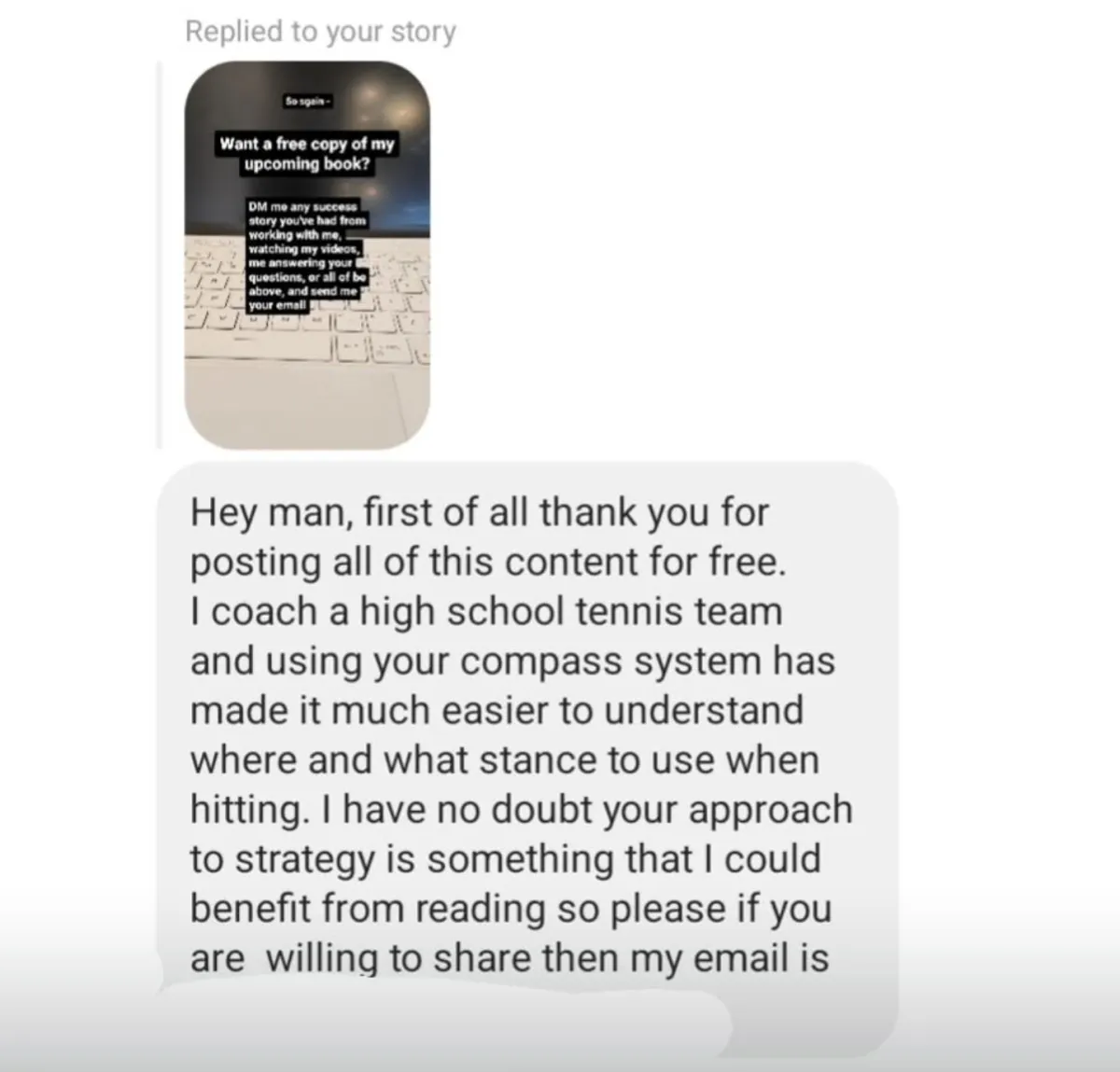
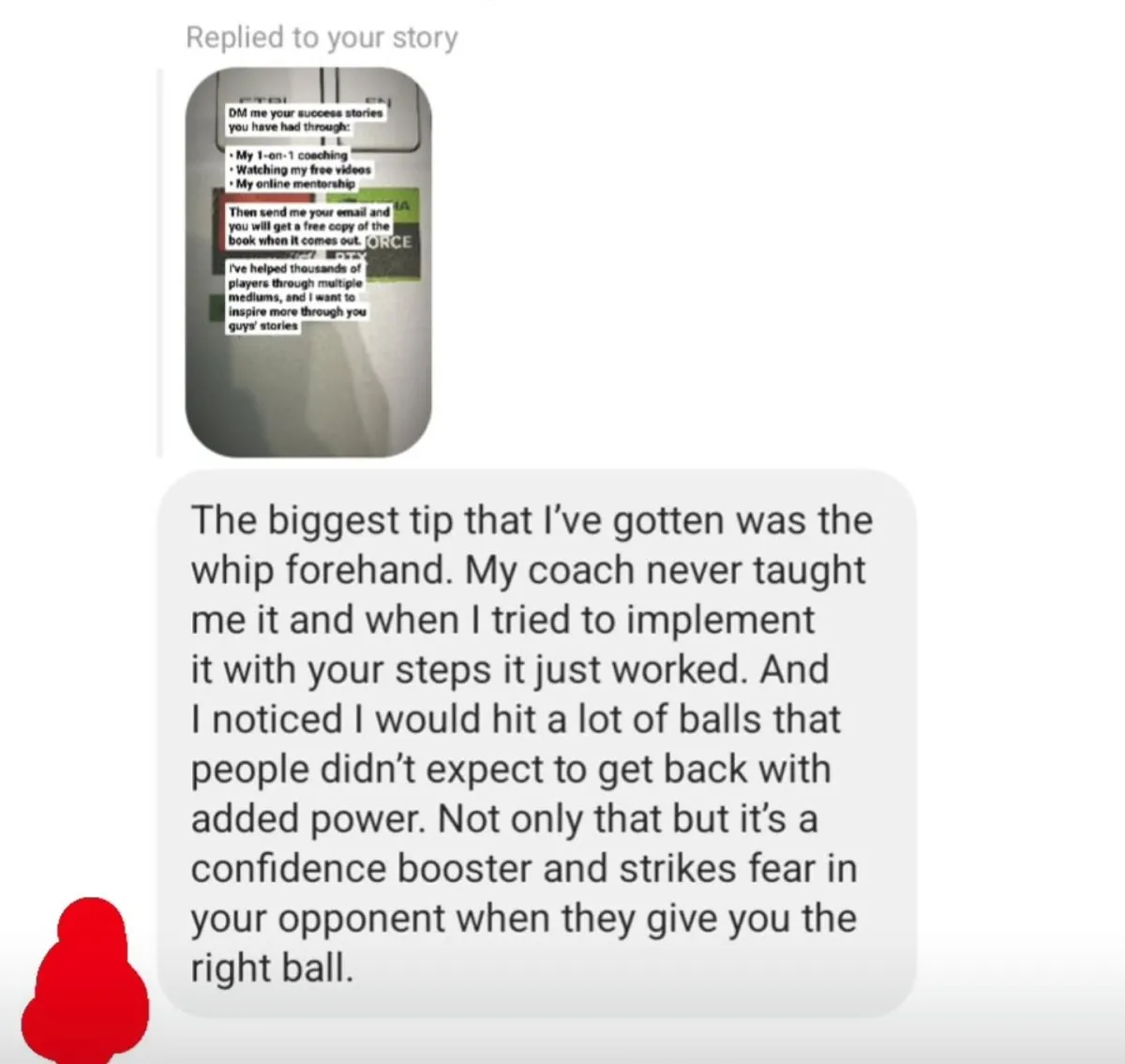
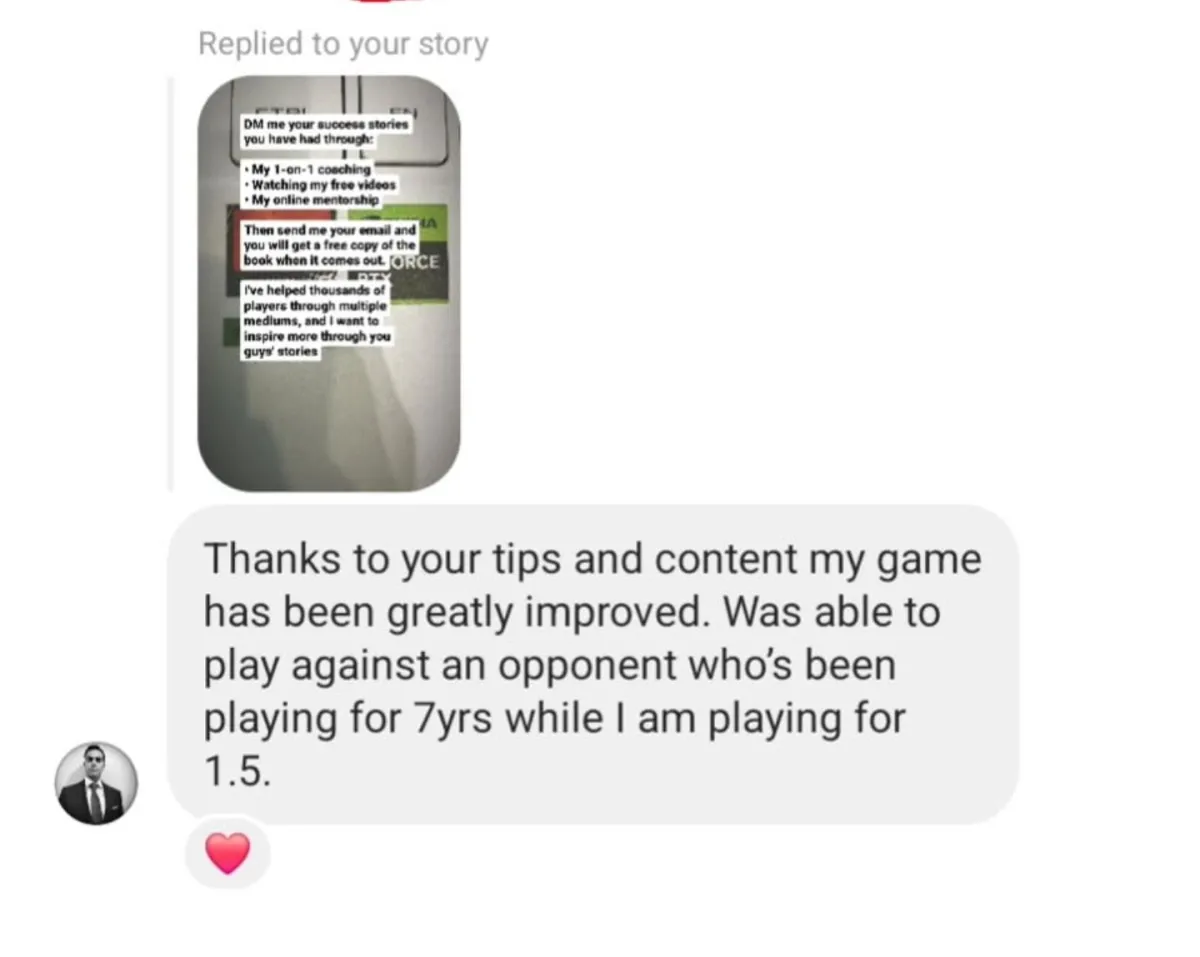
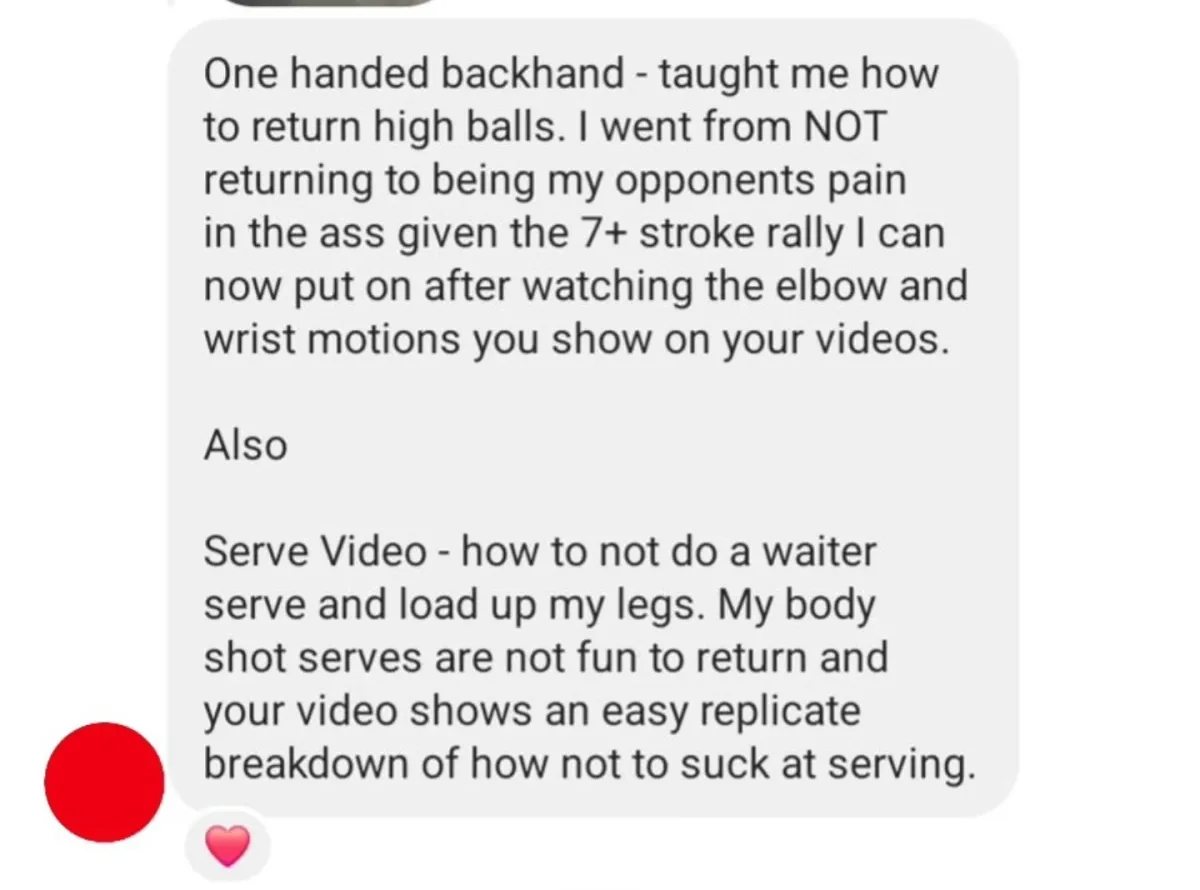
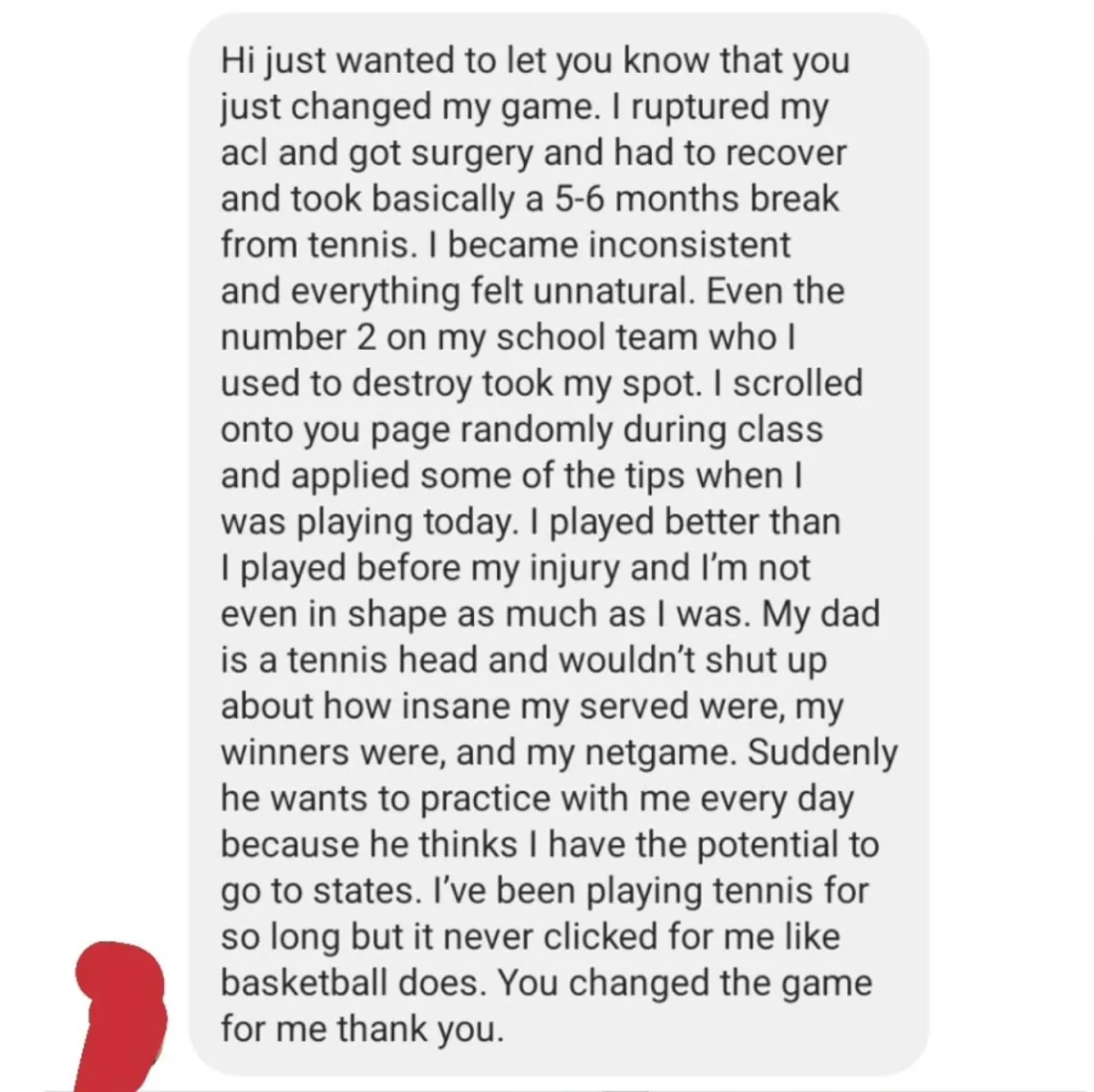
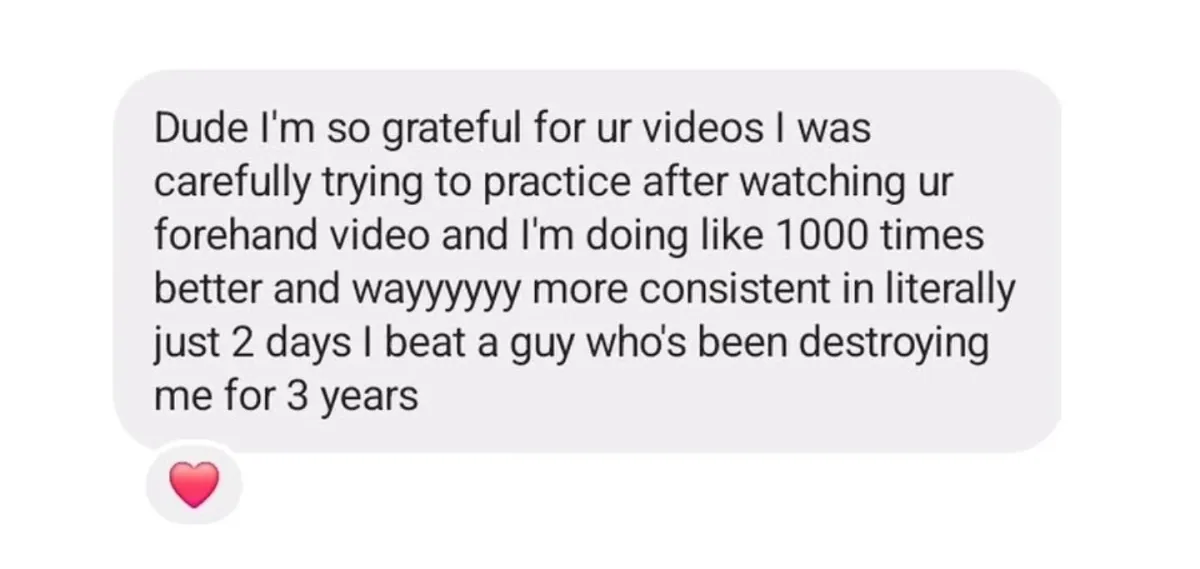
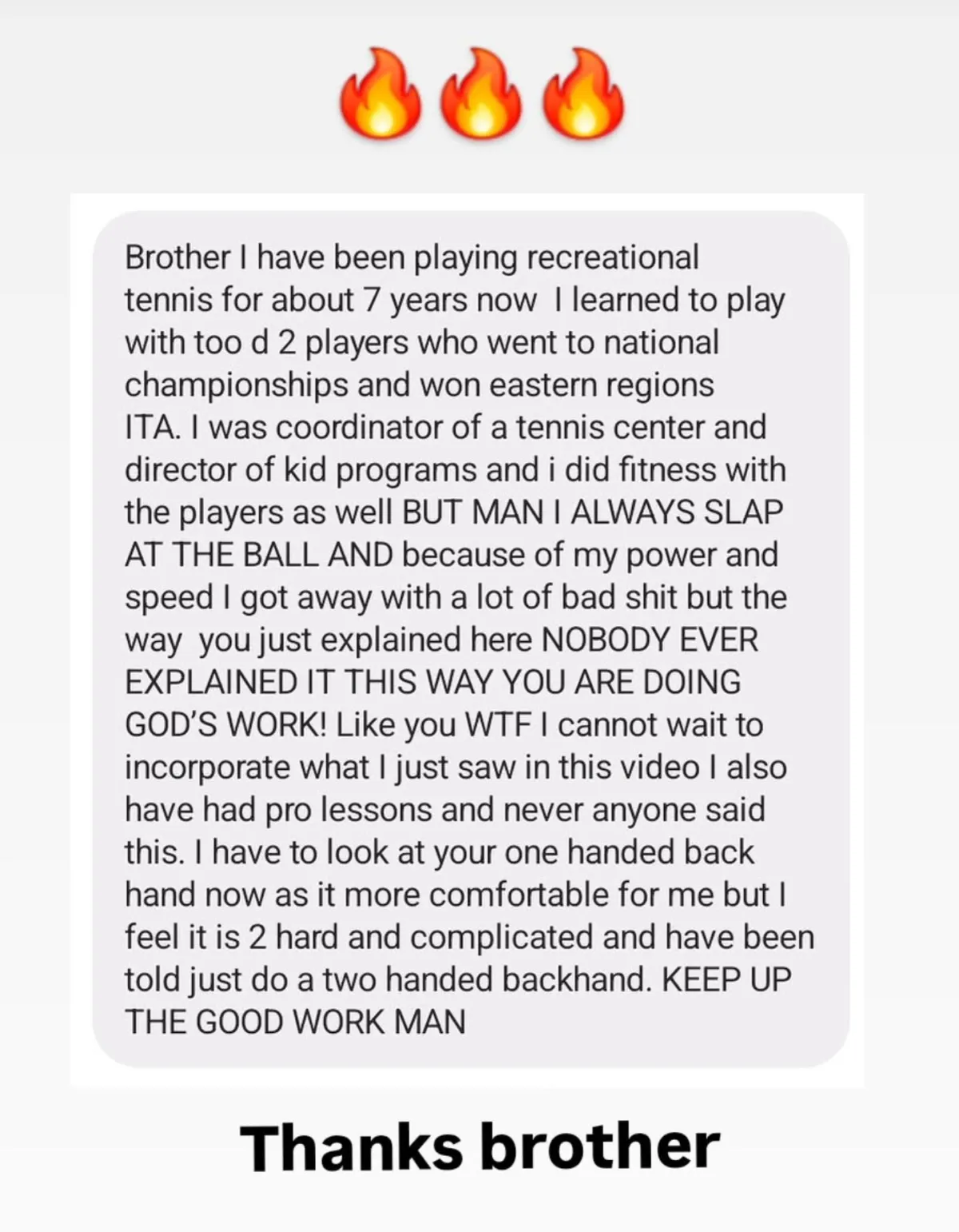
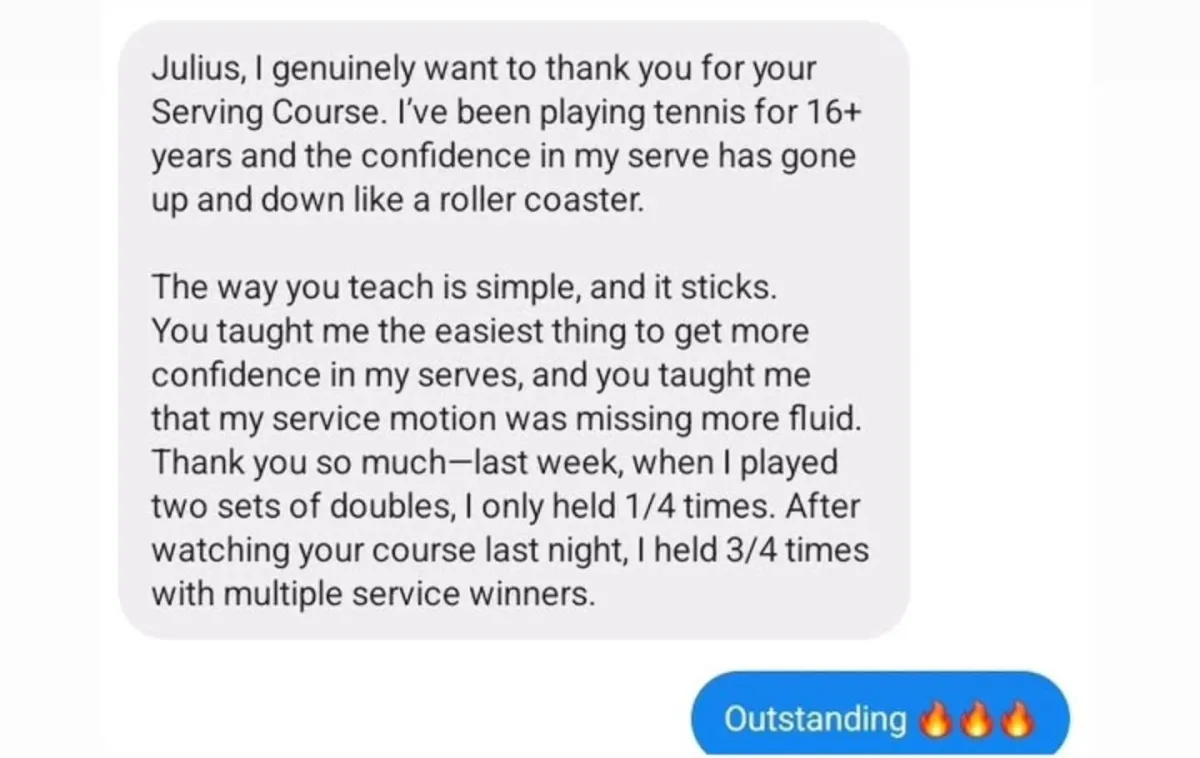
Reviews: